
White Clover: The Herb Growing Right Beneath Your Feet Literally

Hey girl hey,
I want you to do something for me.
The next time you walk outside, stop looking straight ahead.
Look down.
Not at your phone.
Not at your to-do list.
Look at the ground beneath your feet.
Chances are you’ll see patches of little green leaves and tiny white flowers sprinkled throughout your yard, the park, the edge of the sidewalk, or growing between blades of grass.
That’s White Clover.
And while many people see it as a weed, herbalists see something entirely different.
They see abundance.
Because White Clover grows almost everywhere.
It doesn’t demand attention.
It doesn’t need perfect conditions.
It simply grows.
Quietly.
Consistently.
Generously.
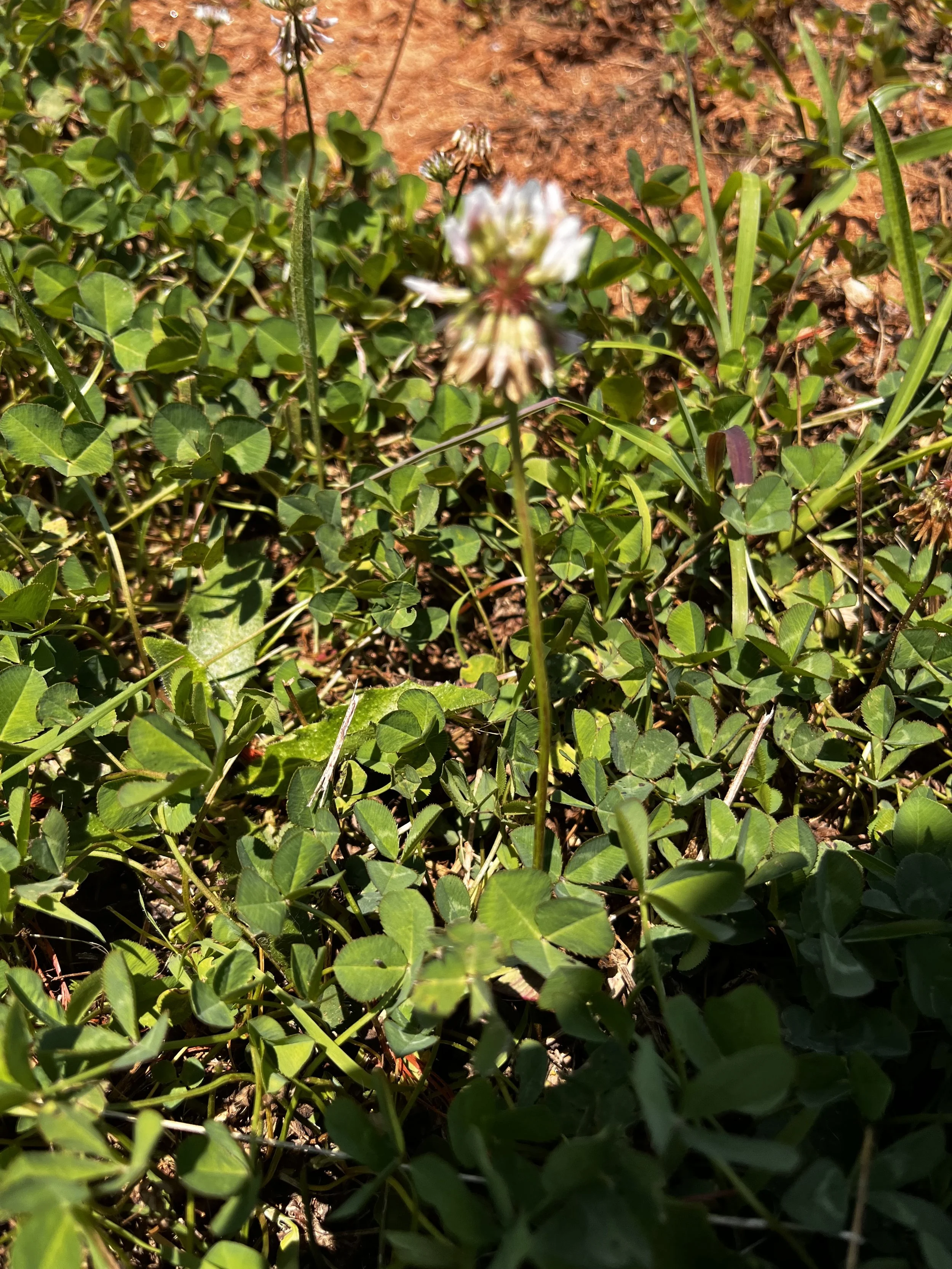
White Clover (Trifolium repens)
is a member of the pea family and is one of the most recognizable plants in North America.
Those little three-part leaves you’ve seen your entire life?
That’s her.
And those fluffy white flower heads that bees absolutely love?
That’s White Clover too.
For generations, people have used White Clover as both a food and an herb.
Yet most of us walk past it every single day without ever noticing.
Traditionally, White Clover has been used as a gentle nourishing herb.
Herbalists have often turned to White Clover as a mild alterative, meaning it was traditionally used to support the body’s natural processes of cleansing and elimination. It has also been used as a nutritive herb, providing minerals and plant compounds that support overall wellness.
Many herbalists view White Clover as supportive for:
• General wellness and vitality
• Traditional lymphatic support
• Seasonal wellness
• Nutritive herbal blends
• Gentle cleansing protocols
• Skin health through supporting the body’s natural elimination pathways
While White Clover is not as widely discussed as its cousin Red Clover, it has a long history of traditional use and remains a valuable plant ally for those interested in the herbs growing right outside their door.
Its flowers are often dried for teas and blended with other nourishing herbs such as nettle, oatstraw, lemon balm, and red clover.
And perhaps one of its greatest gifts is accessibility. White Clover reminds us that herbalism doesn’t always begin with exotic plants from distant places. Sometimes it begins with learning the names and stories of the plants already growing beneath our feet.
Ways To Work With White Clover
Tea
The flowers can be dried and used in simple herbal teas.
Herbal Blends
White Clover pairs well with herbs such as:
• Red Clover
• Lemon Balm
• Nettle
• Oatstraw
• Chamomile
Garden Support
Even if you never harvest it, White Clover is wonderful for the soil and provides food for pollinators.
Sometimes its greatest gift is simply helping everything around it thrive.
What White Clover Teaches Us
I think that’s why I’m drawn to this plant.
Because White Clover doesn’t need to be rare to be valuable.
It doesn’t need fancy packaging.
It doesn’t need a social media account.
It doesn’t need anyone’s approval.
It grows exactly where it is planted.
And it serves.
How many times have we overlooked something simply because it was common?
How many blessings have we stepped over because they weren’t wrapped in something extraordinary?
White Clover reminds me that abundance often looks ordinary.
The medicine is not always hidden deep in a forest.
Sometimes it’s growing right beneath your feet.
